01
One system, one workflow, one onboarding
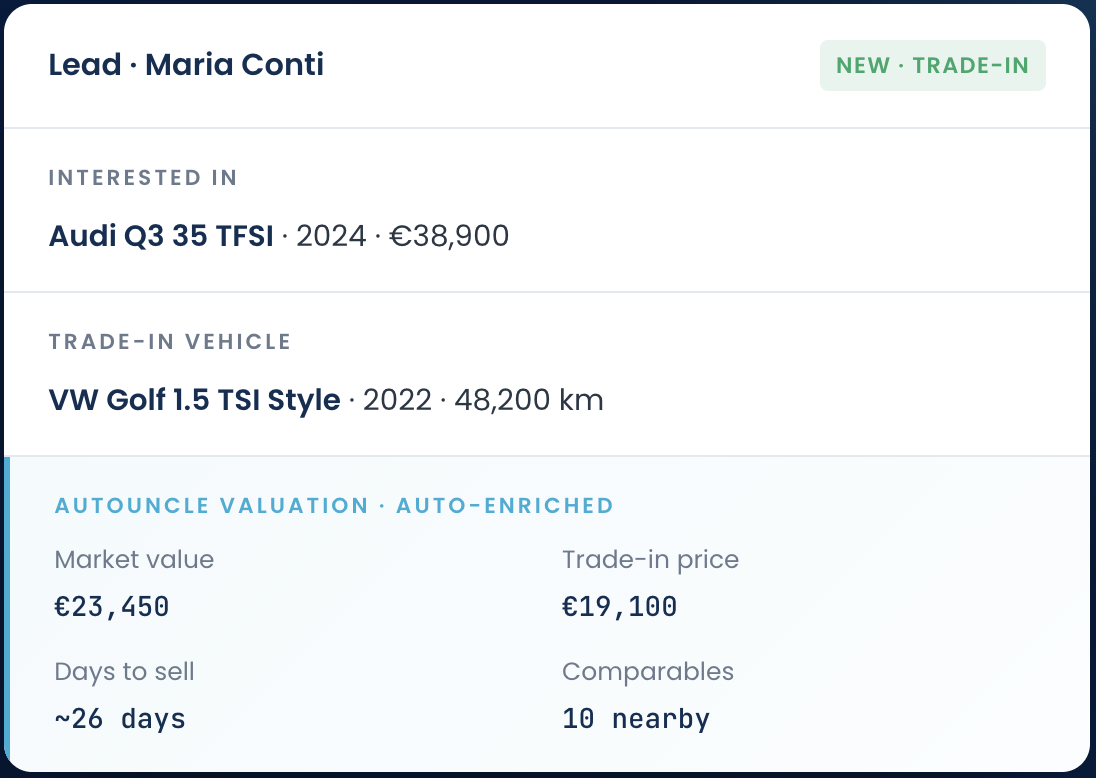
Stop sending salespeople to a separate tool to value a trade-in. Drop our API into your lead detail view and the number is just there — beside the customer's name, beside the car they want next.

CRM SYSTEMS

01
Stop sending salespeople to a separate tool to value a trade-in. Drop our API into your lead detail view and the number is just there — beside the customer's name, beside the car they want next.
02
A trade-in lead with a market-backed valuation closes faster than one a salesperson has to "get back to you" on. Confidence at first contact wins the deal.
03
Already have a trade-in calculator? Use AutoUncle as a second-opinion check that catches outliers before a quote goes to the customer — and protects margin where it matters.
04
CRM workflows touch real customers. A valuation from AutoUncle — a brand consumers visit themselves — lands very differently from one out of an internal black box. Trust is part of the product.

LEAD INTAKE
Parse the registration plate or VIN from the form, hit the API, drop the valuation onto the lead card automatically. The salesperson opens a lead and the trade-in price is already there.
TRADE-IN MODULE
Replace or back up your existing valuation engine with our market value, trade-in price and similar listings. The salesperson sees one market-backed number with its range and the comparable cars behind it.
PRICING ASSISTANT
Embed an inline calculator into deal cards, quote builders, follow-up tasks. Salesperson types a make/model, gets back the market value and the AutoUncle price rating.
STOCK MATCHING
When a customer asks the question every salesperson dreads, the CRM shows the market value and comparable cars on the market — building trust instead of buying time.
FOLLOW-UP TRIGGERS
Run nightly valuations across saved customer vehicles. When a customer hits positive equity — or a model spikes in market value — fire a follow-up automatically. The next deal finds the salesperson.
YOUR USE CASE?
We've likely powered it before. Tell us what you're building and we'll scope an integration.
One endpoint, one response — value, price rating, trade-in price, comparables and selling time. Render any of it directly inside your CRM screens.
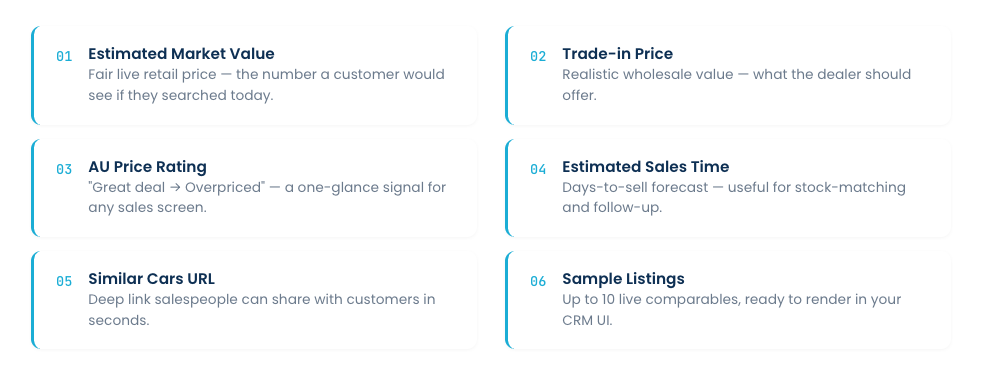
Full schema and examples in the Data Services docs · Valuation API · Use the data you have · Pricing
A TEAM BUILT ON PROACTIVENESS, COLLABORATION AND TRUST
Co-founder and CBDO
Lead Strategic Accounts
Lead Global Marketplace & Partnership CSM
Strategic Partnerships & Data Integrity Lead


CUSTOMER CASE
CUSTOMER CASE
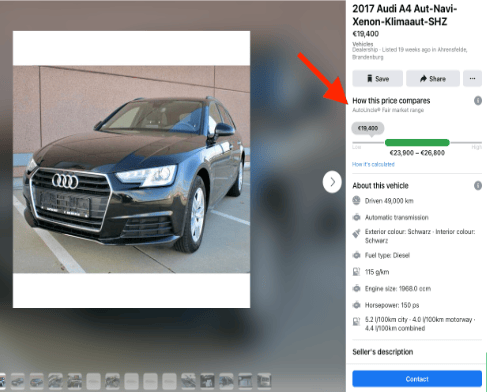
 FACEBOOK MARKETPLACE shows how the price of vehicles compares to others according to AutoUncle.
WHAT ELSE CAN WE DO?
The CRM has always been the system of record for the customer relationship. In automotive, that relationship has a quirk: about seven out of every ten leads come attached to a vehicle the customer already owns. That trade-in is not a side conversation — it's often the deciding factor in whether the new-car deal closes at all. Yet for most dealerships, the trade-in still lives in a separate appraisal tool, in a spreadsheet, or in the salesperson's head. That gap is where deals leak.
A customer walking into a showroom with an existing car is doing two transactions at once — buying a new vehicle and selling their old one — and the two are tightly coupled in their head. The price they're willing to pay for the new car is anchored to the price they think they'll get for the old one. When the salesperson can't confidently quote the trade-in valuation within the first conversation, the customer leaves to "think about it" — and most of the time, that means going to the next dealership over with a better answer.
For years, the dealership response to the trade-in problem was to build more accurate appraisal tools. Useful — but it missed the real lever. The lever is time-to-quote. A valuation that arrives within sixty seconds of the lead landing — even if it's only directionally correct — beats a perfectly calibrated appraisal that takes a day to produce. CRM systems that auto-enrich incoming leads with a live valuation give salespeople a number they can talk through on the very first call. That's where the conversion lift comes from.
The other side of the trade-in equation is trust. Consumers researching their car's value increasingly do so on independent valuation platforms before they ever talk to a dealer — and they walk into the conversation with a number in their head. A salesperson whose CRM is showing the same valuation from the same well-known source isn't negotiating from a different planet. The conversation starts in the same place, which is exactly where it needs to start to close.
